TRCC News
Russian food exporters prepare for Bangkok buyer meetings
More than 40 Russian agricultural producers and food manufacturers are expected in Bangkok on 2–4 December 2026 for over 150 meetings with Thai buyers. TRCC trade data show where commercial flows are established — and where market access remains the central challenge.
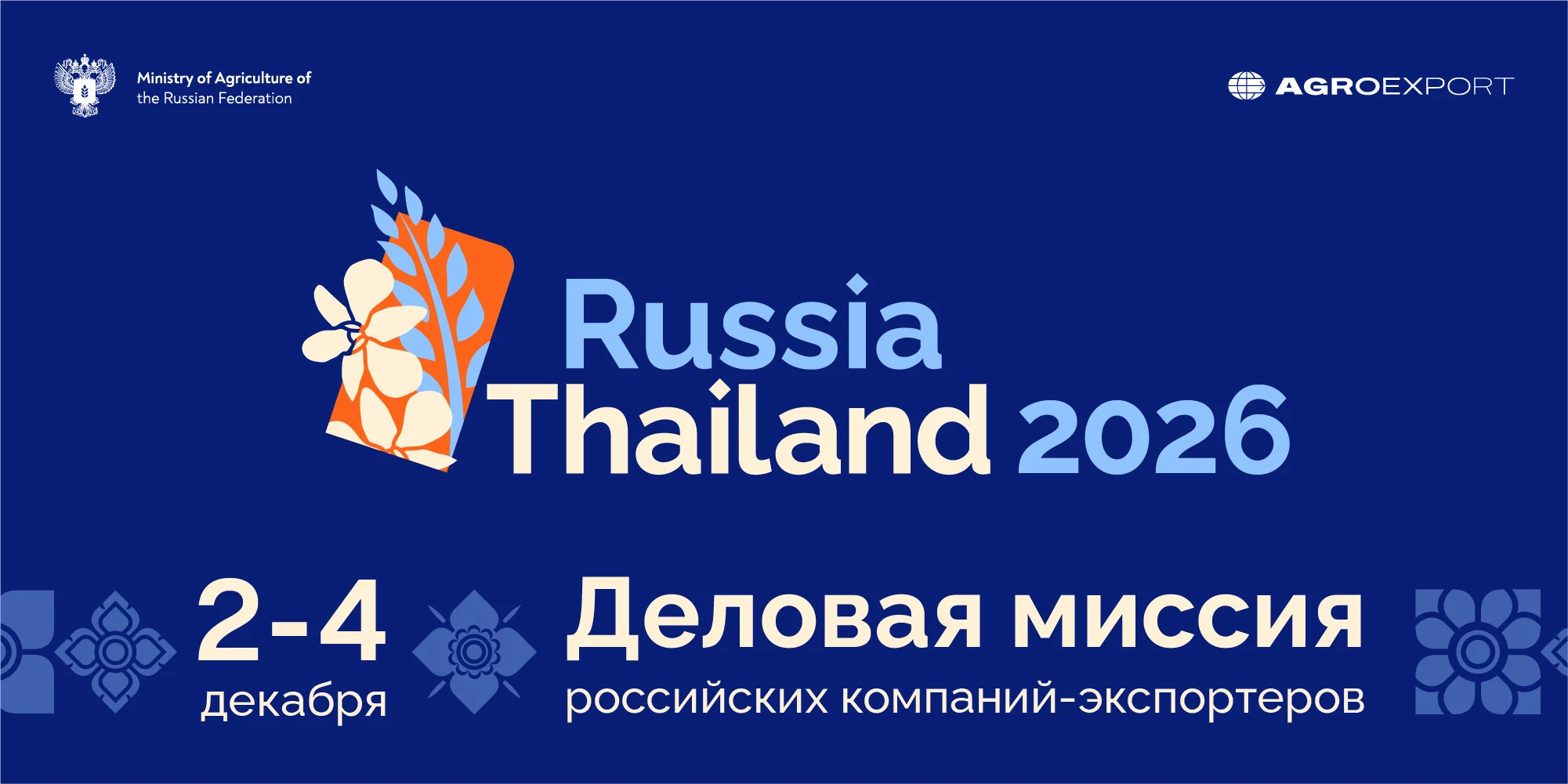
The mission is organised by Russia’s Ministry of Agriculture and the Federal Centre for Agricultural Export Development, Agroexport. The delegation is expected to represent meat, dairy and fish products, infant food, confectionery, alcoholic and non-alcoholic beverages, and animal feed. Agroexport says the Thai side is expected to include importers, distributors, food processors, retailers, HoReCa operators, associations and public agencies.
The programme comes shortly after renewed government-level discussion of agricultural trade at the Russian–Thai Investment Forum in Bangkok. Thailand’s Ministry of Agriculture and Cooperatives reported bilateral agricultural trade of THB 8.228 billion in 2025. That ministry figure uses its own agricultural classification and should not be compared directly with the selected HS chapters below.
What the trade data show
Thai Ministry of Commerce data provide a current view of goods already entering Thailand from Russia. In January–September 2026, the strongest food-related flows among the sectors relevant to the mission were fish and aquatic products under HS 03, at US$20.72 million, and cereals under HS 10, at US$15.57 million.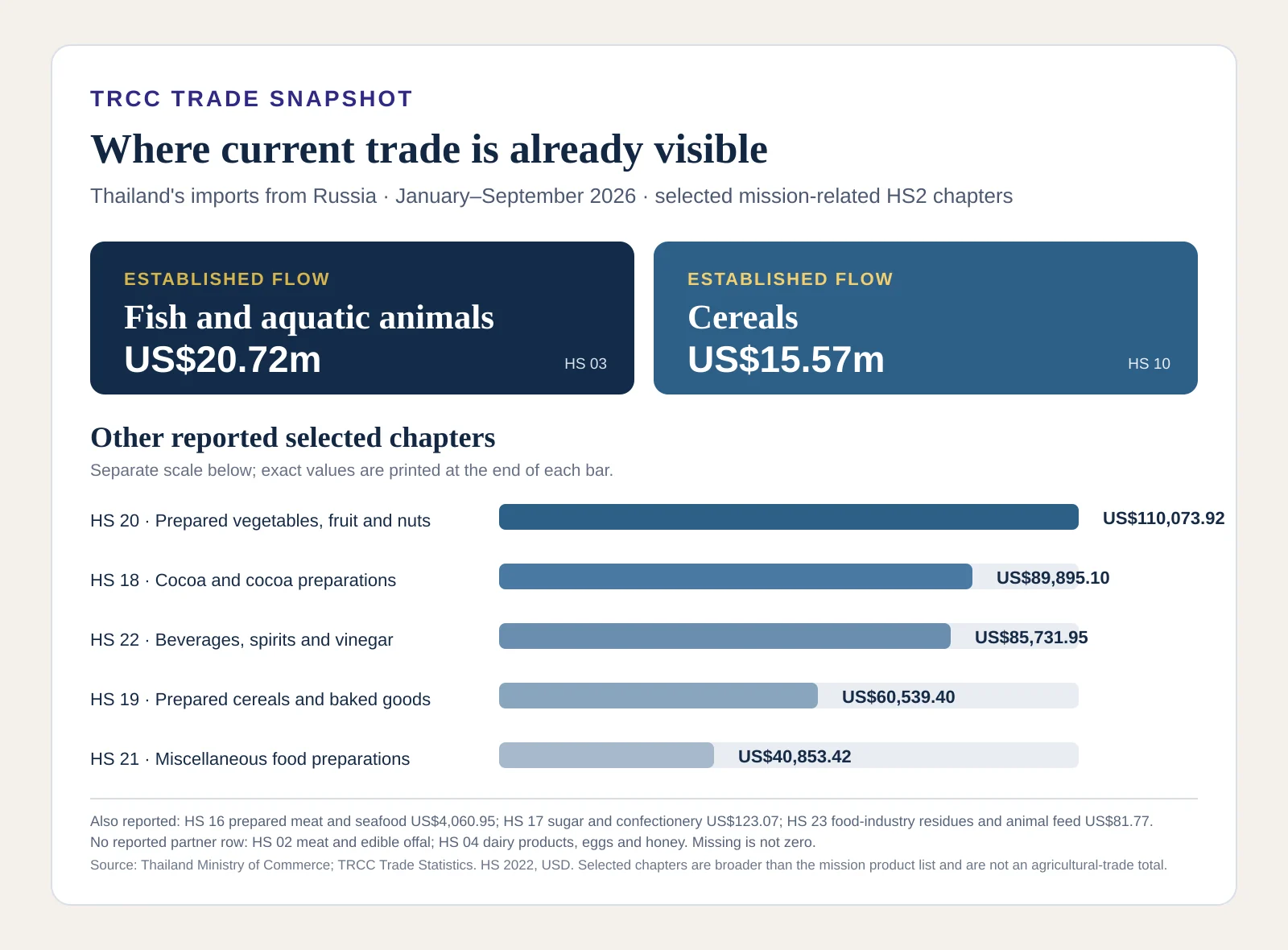
Russia’s supplier position in selected food products, January–September 2026
Thailand imports · partner: RUSSIAN FEDERATION · January–September 2026 (year to date) · USD · HS 2022
Share of the TRCC sum of published reporting countries and territories · common zero-based scale: 0–55%
HS 1001 · Wheat and meslin
HS 0304 · Fish fillets and fish meat
HS 2204 · Grape wine and must
HS 2201 · Water and mineral water
Exact RUSSIAN FEDERATION values, shares and positions · USD
| Product / HS | Imports from RUSSIAN FEDERATION · USD | Share of published-country/territory sum | Position |
|---|---|---|---|
| HS 1001 · Wheat and meslin | 14,453,877.0152 | 1.851446498195828318627148619228% | #7 |
| HS 0304 · Fish fillets and fish meat | 9,977,968.2522 | 3.271429160062155347204648165919% | #7 |
| HS 2204 · Grape wine and must | 45,894.8698 | 0.038711189154899268701757441665% | Outside top 10 |
| HS 2201 · Water and mineral water | 27,597.2334 | 0.147836334619813084478711456488% | Outside top 10 |
Source: Information and Communication Technology Center with cooperation of the Customs Department (MOC Thailand Trade Report). Product links open the equivalent reviewed TRCC Trade Statistics selection.
Denominator: TRCC sum of every published reporting country and territory for the same product and selection; not an official World total.
Method and data notes
Shares use the TRCC sum of every published reporting country and territory for the same HS4 product, direction, period and currency; this is not an official World total.
Only reported MOC rows are compared. Missing or unavailable values are never treated as zero.
The chart shows the three leading suppliers plus the selected partner. An exact position is shown only within the published top ten; otherwise the label is Outside top 10.
Chart labels round shares to two decimal places; a positive share below 0.01% is shown as <0.01%. The exact table retains the frozen decimal share.
HS 2022. Values and labels are frozen to the reviewed sources used at preparation; provisional source data may later be revised.
The data also show where commercial development is still at an early stage. No Russian partner row was reported for HS 02 meat and edible offal or HS 04 dairy products, eggs and honey for the selected period. This is not treated as zero. The US$81.77 reported under HS 23 was soy oilcake and residue, a feed input, rather than prepared animal feed under HS 2309.
These figures are accumulated values for January–September 2026 and are not annualised. The selected chapters are broader than the mission’s product list, overlap with some prepared-product chapters and do not constitute a total for agricultural trade. HS2 and HS4 values are not added together because the four-digit products sit inside the two-digit chapters. Explore the current product data in TRCC Trade Statistics
From interest to market access
For food exporters, a meeting in Bangkok is only the first step. A Thai counterpart may need to act not only as a buyer, but also as the licensed importer, regulatory coordinator and route to the selected sales channel. Product classification, labelling, certificates, storage conditions and intended use therefore need to be discussed alongside price and volume. Siam Trade Development’s Diego Sala discusses export readiness, positioning and distributor selectionThai FDA guidance requires food imported for sale to be handled by a qualifying Thailand-based importer holding the relevant import licence. Requirements then differ by product. Some foods require a food serial number, while qualifying general foods may use the Virtual Number system. Meat, dairy and other animal-origin products may also require product-, country- and establishment-specific work with the Department of Livestock Development. Seafood products are subject to Department of Fisheries controls.
What companies should bring to the table
Exporters can make the planned meetings more productive by preparing:1. An exact product description and proposed HS6 or Thai tariff classification.
2. Ingredients, allergens, nutrition information and preliminary label artwork.
3. Applicable GMP, HACCP, veterinary, catch or halal certificates.
4. Shelf life, storage temperature and cold-chain requirements.
5. Retail, HoReCa or industrial pack sizes.
6. Minimum order, production capacity and lead time.
7. Price basis, Incoterms, currency and payment expectations.
8. Samples, private-label options and a proposal for pilot volumes.
The most useful result is not a general promise of nationwide distribution. It is a defined next step: identify the importer of record, confirm product-specific admissibility, calculate landed cost, review samples and packaging, and agree a pilot shipment for the right channel.
Programme and registration
The business mission will take place at Park Hyatt Bangkok, Central Embassy, 88 Wireless Road, from 2 to 4 December 2026. According to the English invitation, applications from Thai companies and organisations are open until 29 November. Registration is handled by the organiser.View the business mission and apply with the organiser
The trade and regulatory information above is intended as practical business context, not legal advice. Companies should confirm product-specific requirements with their Thai importer and the competent authorities before making commercial commitments.
Event details, registration and documents
Partner Event
From to — Time TBA
Russian Agricultural Exporters’ Business Mission to Thailand
Event time is not yet confirmed
More than 40 Russian agricultural and food producers will meet Thai importers, distributors and industry representatives in Bangkok for personalised B2B talks and industry …
View eventMedia
Photo Gallery