TRCC News
Thai Logist’s Egor Dogonashev compares Thailand–Russia freight routes at RTIF 2026
TRCC member Thai Logist presented sea and rail options between Thailand and Russia at RTIF 2026, explaining transit times, transfer delays and practical route choices for businesses.
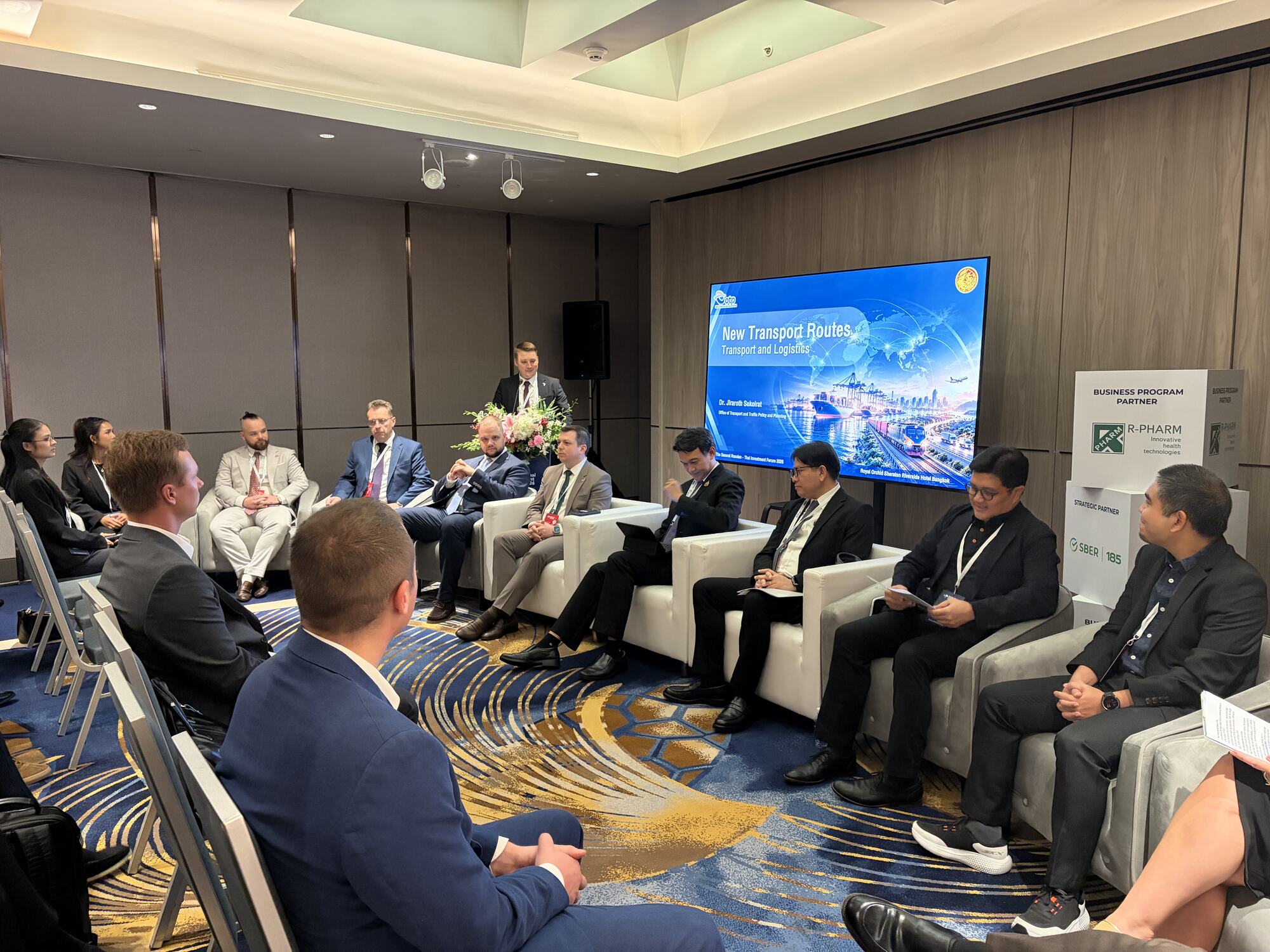
He spoke at the business session “New Transport Routes: Transport and Logistics” at the Royal Orchid Sheraton Riverside Hotel Bangkok. Moderated by Yuri Marinich, Founder and CEO of CDEK Thailand, the session examined transport links, port infrastructure, digitalization, customs procedures and the practical barriers facing bilateral trade.
For the wider discussion, read the session report featuring Yuri Marinich of CDEK Bangkok.
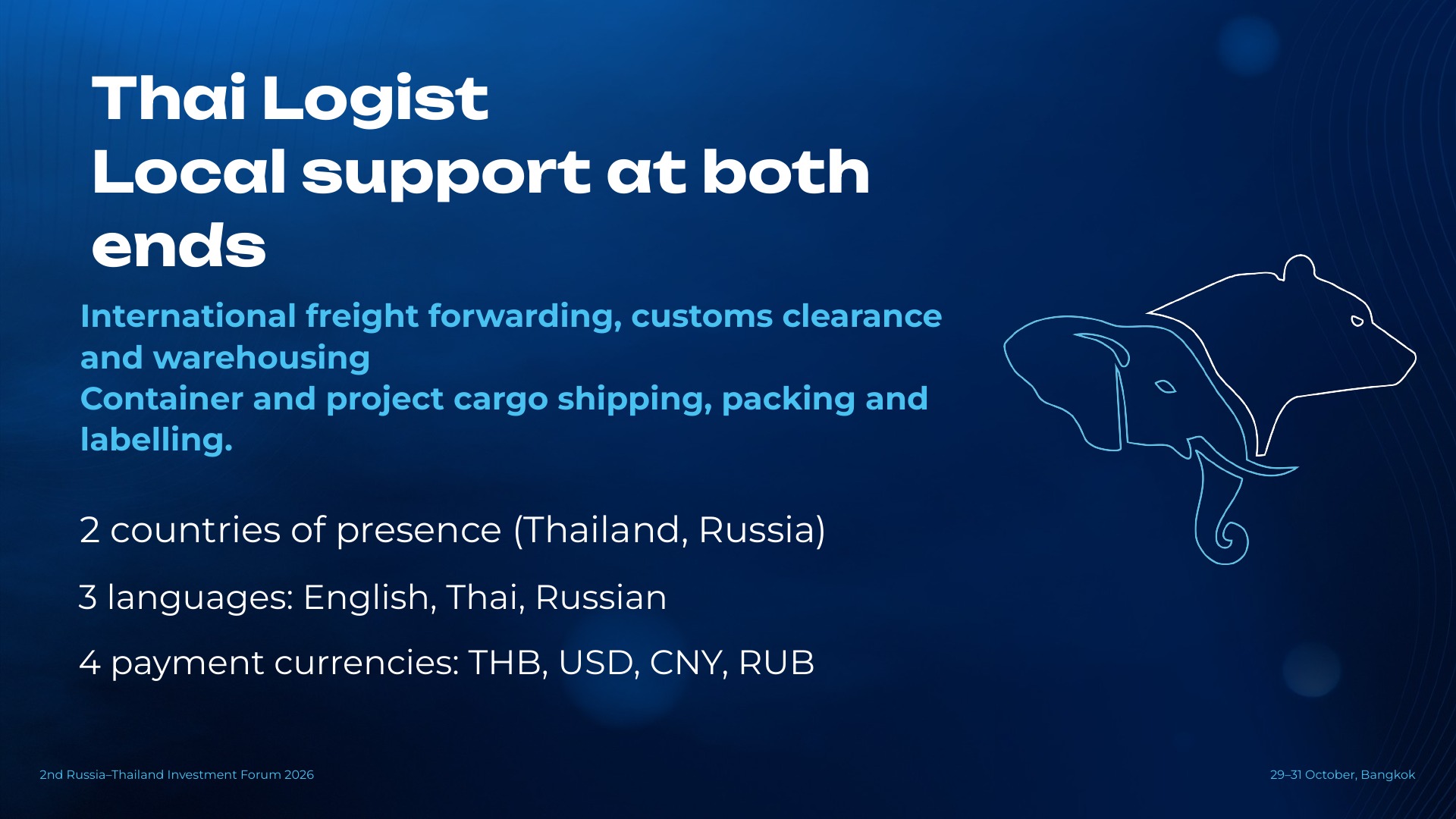
Local support across the transport chain
Thai Logist provides international freight forwarding, customs clearance and warehousing, including packing and labelling, as well as container and project cargo services. Dogonashev described the company’s role as arranging and supervising shipments from supplier to customer across sea, rail and road connections.According to his presentation, Thai Logist is part of a five-company Logist group with offices in Bangkok, Vladivostok and Moscow. The group provides support in English, Thai and Russian and accepts payments in Thai baht, US dollars, Chinese yuan and Russian rubles.
Routes through the Far East, China and western Russian ports
The presentation identified Bangkok and Laem Chabang as the principal Thai gateways. The Far East option runs via Busan to Vladivostok, with onward delivery by rail or truck. For western Russia, sea services connect Thailand with Saint Petersburg and Novorossiysk through transshipment hubs such as ports in China, Port Klang or Nhava Sheva.A further option combines sea transport to China with rail services to Russia, using hubs such as Xi’an, Chengdu and Zhengzhou. Russian destinations include Moscow, Novosibirsk and Yekaterinburg. The network can also support Russian exports to Thailand, although schedules and container availability need to be checked separately for each direction.
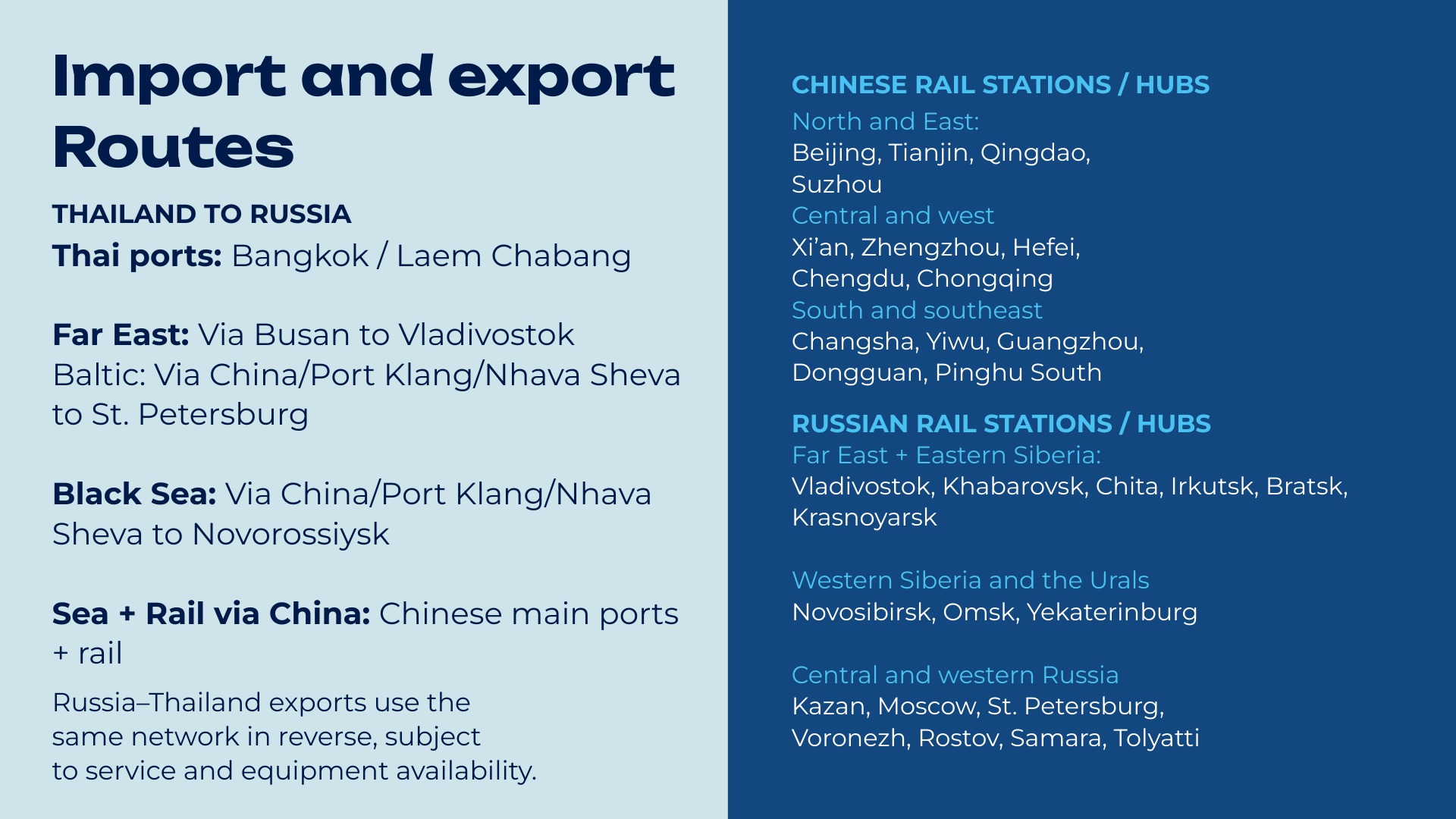
“A fast sea service helps only if the container can continue inland without a long wait,” Dogonashev explained in his presentation.
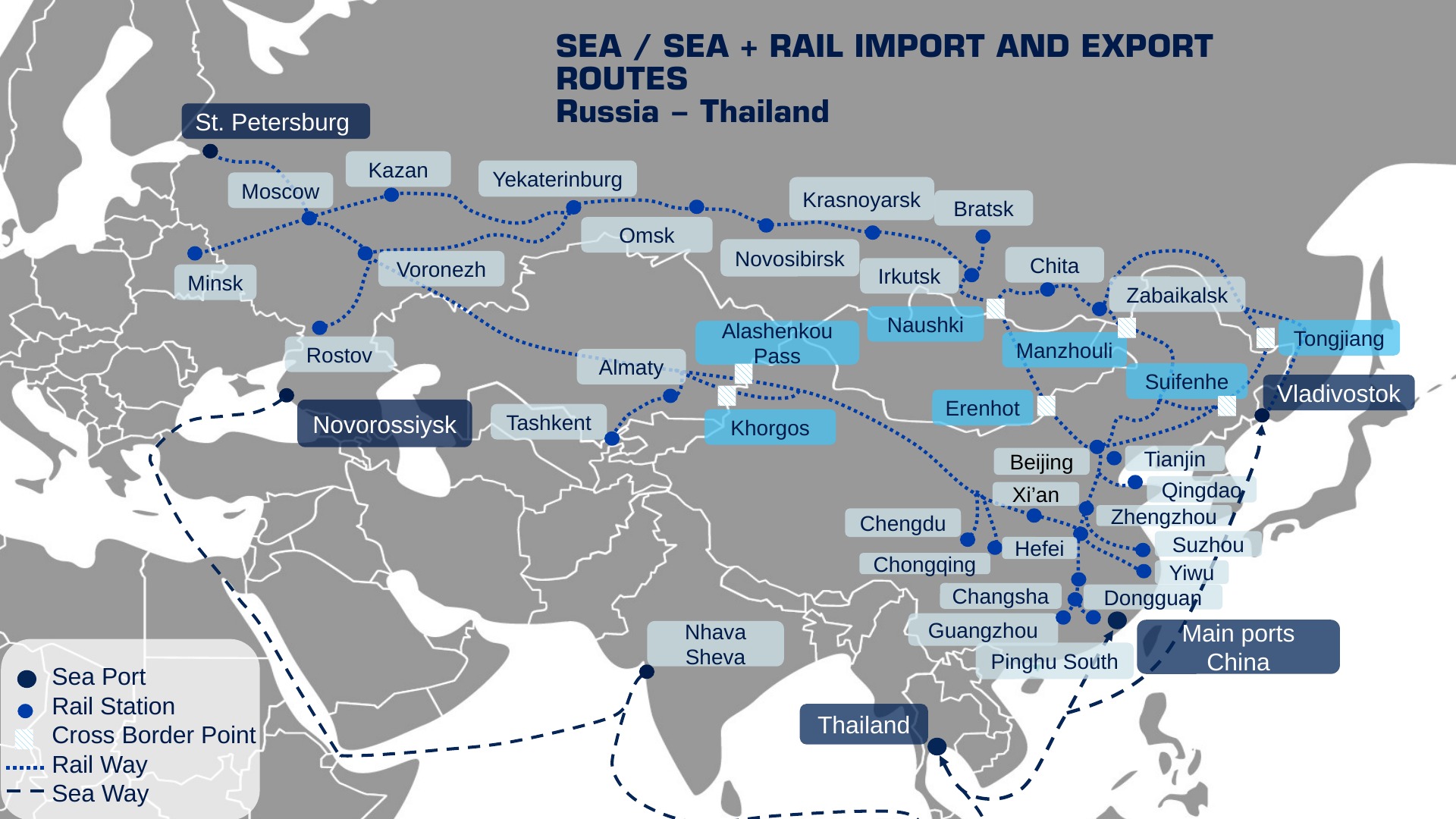
Transit estimates: compare the same journey
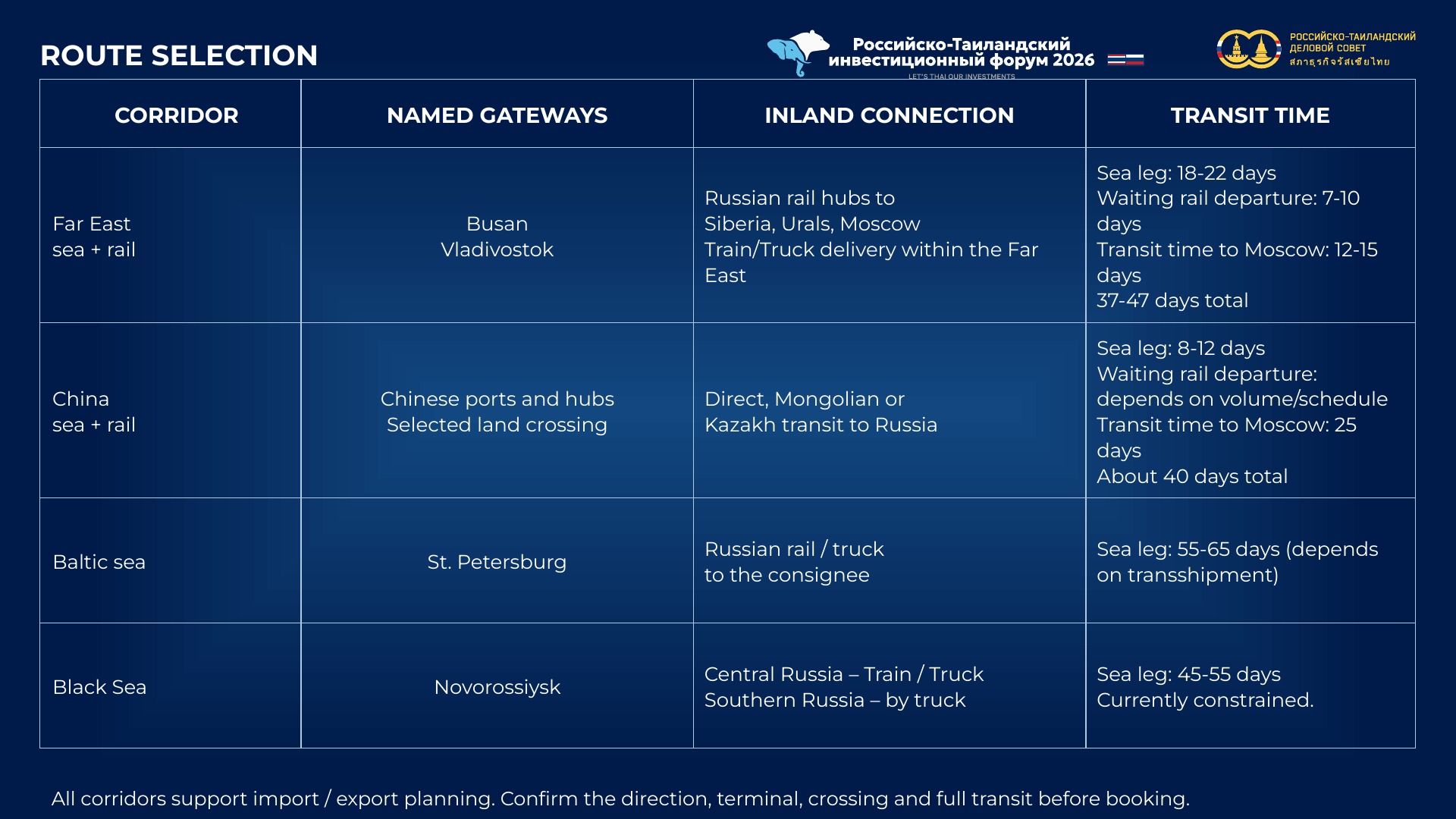
Dogonashev presented the following planning estimates. They reflect his assessment on 30 October 2026 and are not guaranteed delivery schedules.Via Vladivostok to Moscow: 18–22 days at sea, 7–10 days waiting for rail departure and 12–15 days by rail to Moscow — approximately 37–47 days in total.
Via China to Moscow: 8–12 days at sea and around 25 days by rail, with an indicative total of about 40 days. Waiting time depends on cargo volume and the train schedule.
Via Saint Petersburg: approximately 55–65 days for the sea leg, depending on transshipment. Inland delivery must be added.
Via Novorossiysk: approximately 45–55 days for the sea leg. Dogonashev described the Black Sea route as constrained at the time of the presentation and stressed that service availability must be confirmed before committing to delivery dates.
The Far East and China figures cover transport to Moscow; the Baltic and Black Sea figures cover only the sea leg. Customs, terminal handling and local delivery can add time, so the four figures should not be treated as directly comparable door-to-door estimates.
Practical considerations for importers and exporters
Dogonashev highlighted transshipment delays, rail departure schedules and service availability as key planning risks. He said constraints on the Novorossiysk route had shifted cargo towards Saint Petersburg and Vladivostok, adding inland transport time for deliveries to southern Russia. Rail options through China also require suitable volumes and cargo values to be commercially attractive.Based on Thai Logist’s operating experience, he identified Vladivostok as the company’s most effective route for shipments to and from Thailand. The appropriate choice for an individual shipment still depends on its destination, cost, cargo requirements and confirmed connections.
He invited cooperation with trading companies, carriers and logistics partners to improve delivery reliability and support Thailand–Russia trade.
The five slides reproduced with this article were supplied by Thai Logist. Route descriptions and transit estimates are attributed to the company’s presentation.
View the II Russian–Thai Investment Forum 2026
Contact TRCC about business cooperation
Documents
Thailand–Russia Multimodal Routes — Thai Logist at RTIF 2026
Five-slide presentation by Egor Dogonashev, Director of Thai Logist, at the session “New Routes for Cooperation: Transport and Logistics”, II Russian–Thai Investment Forum, Bangkok, 30 October 2026. Includes services, a route overview, a sea/rail map and indicative transit times. Figures are company planning estimates on the presentation date; Moscow totals and sea-only estimates have different endpoints. PDF exported from the supplied PowerPoint.
Event details, registration and documents
Partner Event Russian-Thai Business Council (RTBC)
From to
II Russian–Thai Investment Forum 2026
The II Russian–Thai Investment Forum brings companies, institutions and business associations from Russia and Thailand together in Bangkok for three days of investment dialogue, …
View event